Reflective Notes: International Online Collaboration in Project Work

4 Comments

In the context of the seminar „Learning Theory and Pedagogical Use of Technology“, the second phase of the course consisted of an international online collaboration on the creation of a teacher’s handbook containing information on the use of educational technology in various virtual and physical “classrooms”. This article reflects the circumstances of its implementation. I would like to point out the positive aspects first and then turn to the more challenging and stressful situations that our study team was confronted with.

To work together with students from a variety of countries solely in online environments like Adobe Connect, Facebook and Google Drive was clearly a new and exciting experience for me. The introduction video provided by one of the faculty’s researchers was very helpful, pointing out especially that discussions and proposals in the online forum should be based on sound theoretical work and on professional experience, avoiding commonsensical and ad-hoc contributions.

Once the actual collaboration had started, it was interesting to see how the group dynamics between the actually participating group members developed. Also, the quality and steadiness of the collaborative work between the group members that knew each other in person before (our group here in Finland) was very satisfying and rewarding. The content-related work blended well with the activities in the field, where we visited a course for senior ICT learners, which was the teaching environment that we had to focus on. Also, the experience of a jointly held, ICT-enabled virtual presentation including our fellow students from Estonia and Norway was an interesting and fascinating experience – although we didn’t know each other, a certain feeling of togetherness among the groups had developed during the fulfillment of the task.

Nevertheless, all in all it can not be said that this international collaboration was a satisfying experience. From the first meeting on, there was only few members of the group actually participating, and those who showed initiative had apparently been poorly instructed by their teachers or had received no instruction at all, as the identification of the task already posed a major challenge for them. Our local group tried to fix this problem by offering our understanding of their role in the collaboration, but for some reason these recommendations were not taken up, leaving a feeling of pointlessness right from the start. One of the major problems besides the physical or virtual absence of many group members in the meetings and group work was the technological problems we encountered, especially with the Adobe Connect environment. Only four of the 6 relatively active group members (the actual group size was 9) could establish audio connection, while 3 of those belonged to the Finnish group. Also, the students in Estonia and Norway had apparently not been introduced to and familiarized with the Wiki environment.

I think getting into the details of the group work done would include too much petty charging the work done and tasks fulfilled against those not fulfilled by the various group members. Nevertheless, a definite low of the “collaborative” work was reached with the total drop-out or inactivity of the team members from Estonia and Norway in the final phase, when the presentation and the final version of the handbook had to be edited. It was actually during this last phase in which my frustration with the project reached its peak, especially because the pressure to wrap the project up rose significantly and regardless of this situation 6 of our 9 group members just didn’t react to the Finnish team’s demands to participate at all. After the presentation and handbook chapter were done, of course, everybody was fast in giving their thanks. I actually found an interesting and charmingly done instructional video by Marina Kostina focusing on that topic, have a short look (it takes 4:46′):


This brings me to my central point: I think that in collaborative learning, and in online environments especially, the problem of free riding should be addressed more openly and consequently, both in theoretical reflection and in the actual implementation of courses. Maybe the contributions of each group member could be evaluated also during the work period and the tutor (who, in our case, was completely passive) could prompt inactive group members to contribute. I have recently made many negative experiences in collaborative learning and work, almost to the point that I would say that the idea of collaboration in the classroom is delusional if there is no mechanism installed in order to monitor the group member’s individual activities and contributions. Obviously, some learn a lot during these group sessions, but others might have learned through experience that it actually pays to not invest time and energy, as grades will be given to the group product. Free-riding will thus bring a relatively good result with a minuscule amount of work. Of course, mastery-oriented students in the group will always work for a good result and will all too often do literally all the work for a group’s presentation – as the social norm of not reporting the fellow student’s inactivity is still holding strong – which it should be. I think it is in the responsibility of the course designer and instructor to establish ways of monitoring and controlling a fairer distribution of work in academic collaborative learning groups. An interesting strategy in this regard could be to give the students tasks that require them to contribute to the group’s work through “interdependent learning”. Some examples for this kind of learning and many other helpful ideas for the realization of an international collaborative web-course can be found in the fourth chapter of the handbook our web-course produced. It is interesting to note that the teacher plays a central role in both the theoretical and practical implications discussed in this handbook chapter.

Nevertheless, I am happy to present the results of our work here, as I think the participating students have done a great job, especially regarding the challenging circumstances:

 The Handbook Chapter on “Technology Learning for Senior Learners”

Our presentation given during our virtual international final session of the course:


Event Note: Online Educa Berlin 2012

Leave a comment

A post on the Online Educa Berlin (OEB) 2012 on this platform is a must, as it seems to me. I was actually not aware myself that the yearly event of the scene is regularly taking place in my “exciting” hometown, as the conference promotional video puts it – well, I do agree, of course.. The conference traditionally seems to bring together many researchers, educators, policy makers, company representatives and IT developers in order to network, take part in workshops, attend lectures and, of course, exchange business cards – and I am in a way sorry I can’t take a peak, as I will still be in lovely but ever darker, autumnal Finland.


Link to OEB’s homepage: http://www.online-educa.com/

An interesting detail that occurred to me while watching the promotional clip is that the “Creative Classrooms” initiative by the European Union seems to be featured prominently in that expanding word field half-way through the video. This initiative – that I happen to focus on currently for an essay on educational policy – was actually only launched one year ago at the OEB 2011 by the European Commission. That the conference now is realting to the concept in a subtle, yet apparent manner is an interesting insight in the workings of political and conceptual “diplomacy” in conference design – please note that the event is under the patronage of Germany’s Federal Ministry of Education and Research.

Research Spotlight: Scenarios for a Digital Europe in 2030

Leave a comment

I am currently preparing an essay on the EU’s “Digital Agenda” as a part of the “EU 2020” strategy that is in these days replacing the Lisbon Strategy as the main policy guideline. As to educational policy content, they don’t really seem to differ in the main “human capital” approach, although the tone of voice is getting somewhat more pressing and the internal cycles of evaluation of the member state’s progress on NRPs (National Reform Programmes) by the European Council are getting tighter, all because of a claimed urgency of the response to the crisis. No democratic process is controlling the measures the Commission and the heads of the member states (the Council, that is) are taking in Brussels, which makes a policy that is driven by fear and urgency in my view even more questionable. It will be hard to take certain reform decisions back once in place. This holds true also for the streamlining of educational systems in Europe in collaboration with employers, that is, economical interest, envisioned by the „EU 2020“ strategy.

Once finished, I will link my essay on this blog, but right now, I wanted to draw your attention to a study I encountered that does not relate directly to education, but to “E-Governance”, as it is called.

Image

This study was led by the Joint Research Centre at the Institute for Prospective Technological Studies, which is directly linked to the European Commission. It develops possible scenarios  of how we might be governed or govern ourselves in the near future that could be brought about by the development in ICT solutions for the processing and planning of information on societies.

The gathering and digital processing of “policy intelligence” in order to achieve digitally enhanced “policy modeling” is at the heart of the matter, and the four pages that include the summary that I linked above are definitely an exciting read. As a teaser, I included the figure that maps the four scenarios identified by the researchers. In reading through the descriptions, I unfortunately must say that many “neoliberal”, human capital-oriented developments and policies to be found in Europe and elsewhere currently could be dangerously pointing towards the lower right situation, in which that poor man doesn’t seem to remember anymore how to take off those nasty-looking goggles.

The development of educational IC Technologies should take these risks into account and be aware of what approaches these can be instrumentalized for. In my view, pedagogical and technological designers of learning environments can and should play a crucial role in accompanying the rise of e-government through the development of meaningful and ethically conscious tools for political and civic education.

For more information, please follow these links:

http://www.foresight-platform.eu/wp-content/uploads/2011/11/EFP-Brief-No.-194_Digital-Europe2030.pdf (Report Summary)

http://ftp.jrc.es/EURdoc/JRC61593.pdf (Complete Report)

http://crossroad.epu.ntua.gr/ (The Crossroads Project, of which this report was one part)


Presentation: Education Reform According to Trilling & Hood

Leave a comment

In the context of my studies on “Education in Transition”, I held a short presentation today on the life and works of Bernie Trilling and Paul Hood, specifically their article “Learning Technology and Education Reform in the Knowledge Age or “We’re Wired, Webbed and Windowed, Now What?” from the journal Educational Technology (1999) that can be accessed at http://www.wested.org/online_pubs/learning_technology.pdf

I wouldn’t fully recommend the lecture of the article, anyway. The arguments of Trilling & Hood are brought forward mostly in a commonsensical fashion, stating “facts” on the state of the “Knowledge Age” without referencing many of them. It is, in my view, a good example of academics lobbying for the liberalization of the “education market”, which is indeed troubling from my European point of view. Nevertheless, their ideas on “Alternative Learning Centres” are interesting and fairly convincing.

Reflective Notes: After the Introduction to Learning Theories

2 Comments

In the context of a course on „Learning Theory and Pedagogical Use of Technology“, our study group was introduced to three basic theoretical concepts: self-regulated learning, collaborative learning and expertise.

Every module of the course was split in three steps that were repeated for each topic to be learned: lectures, individual preparation of an introductory text, study circles in smaller groups and a final exam, assessing the knowledge on the matter. This structure is certainly well thought through and quite efficient, especially as the notion of an „exam“ raises the level of pressure on the students and makes them engage more deeply with the matter. Also, the lectures were held by a variety of presenters, each experts in their field of research, which also offered interesting examples of the application of the theories to be learned.

Nevertheless, there were two aspects of the implementation of this strategy that I would like to discuss in detail. First, the presentations were sometimes heavily loaded with detailed and advanced information that made it hard to follow the lecturers and therefore grasp the concepts at the heart of the matter. Therefore, establishing a discussion on the theories presented was difficult and an opportunity to make use of prior existing knowledge among the students might have been lost. Secondly, especially regarding the choice of the third mandatory reading, „Teacher learning in the context of educational innovation: Learning activities and learning outcomes of experienced teachers“ by Bakkenes et al., the articles sometimes seemed to be too specifically centered on empirical findings and methods and didn’t focus enough on explaining and highlighting the basics of the theories involved. The concept of expertise, for instance, was briefly introduced during the lecture, but that knowledge was only vaguely deepened in the article given for home study.

Regarding the international online collaboration phase with students from other European universities, I am very much looking forward to this opportunity of engaging in computer-supported collaborative learning (CSCL) in practice. Anyway, the simple assignment of fields of research to the work groups appeared to be a solution that is based on lack of time rather than didactic strategy. Enabling students to engage in a thematic field relevant to their professional or research interests might support intrinsic motivation though. This could be resolved, for instance, by offering students a choice from a list of topics presented in advance, having them choose a top 3 of favorite topics that can then be then computed for matchmaking (e.g. in a Doodle environment). On the other hand, the assignment of topics trains the students in flexibly reacting to externally presented tasks, a common reality in many professional environments and therefore a good preparation for future work and evaluation research scenarios.

Generally speaking, I was sincerely thrilled to have been confronted with crucial topics of current research on LET and have surely been inspired to further look into some of the approaches highlighted. I feel privileged to participate in an international collaborative project and am very curious regarding the work in our team and its results.

Reflections on the Affordances of Social Media in Education

7 Comments

The concept of affordances has been developed by J. J. Gibson in the late 1970s as part of his writings on „ecological psychology“. According to Gibson, the niches that animals and also humans live and thrive in are not formed by their habitat, but by the opportunities of action that these surroundings offer the life forms in question. Especially when it comes to humans, the role of the perception of opportunities by individuals or collectives becomes an important topic: only those possibilities of action that are understood and deemed possible will be considered options, or affordances. Another interesting detail of the paralleling of animals and humans is that, while they both exist in physical and social habitats, human social habitats or societies are much more flexible and changing over space and time than those of animals and make the concept of affordances much more manipulable and variable.

A short, simple and fun introduction into what affordances are was given by usability guru Don Norman in 1994, available on YouTube –with an interesting twist in the end:

Affordances are perceived possibilities that habitats offer their inhabitants – and as the world we live in nowadays, so to say our habitat, is in many corners made up by digital, virtual or at least technological environments, the affordances of applications, softwares and tools are an important topic in the design of educational technology. Regarding the affordances of this blog, for instance, in a short brainstorm I came up with five affordances related to actions: post content, include a variety of media, stay in touch with and follow other bloggers, comment on other’s content, reach out to a certain community and campaign for one’s insights and ideals. Thinking about it again now that I re-write this text, I could add some more affordances: including widgets for RSS feeds from other websites, linking my blog to twitter and Facebook accounts or categorizing my entries by certain topics, thus establishing a frame that I try to give my readers when they go through my content. And – I am sure these are not all affordances that a blog has to offer, and all the affordances that could be thought of now are probably not what the designer of the world’s first blog tool had in mind. This flexibility of the concept of affordances is what I find the most fascinating detail, especially in regard to its application to social media and other digital tools. We can probably never say that we have identified all possible affordances of a tool yet, and in case we might be involved in the design and combination of, say, instructional tools, we can never imagine all of the uses that the users might put them to, discovering new affordances as they go. This seems especially true as technological tools are being developed further constantly and can often be combined with newly designed applications, offering new affordances through joint usage.

As to the categorization of affordances by social, cognitive and emotional/motivational aspects, it might be first said that these can in my understanding intertwine and even determine one another. Good examples for the social affordances of blogs might be: staying in touch with other bloggers or co-developing content and knowledge through rss feeds, commenting functionality and the “Blogs I Follow” landing page. Cognitive affordances of blogs might include the publishing and hence externalization of reflections and the need to produce relatively short texts which includes a built-in necessity to identify core issues and key factors in the topics discussed. Finally, emotional or motivational affordances can be identified in the reward that positive feedback on published content offers in form of comments, likes and recommendations by peers – also, the possibility to be seen and found by potential employers, research institutions and new blog and research peers might represent a motivational incentive to use blogs as tools in training and education.

Online Discovery: iEARN – International Education and Resource Network

1 Comment

Last week, I came across an inspiring project while surfing the web. iEARN is a global learning and education initiative of stunning proportions that has been going on for almost 25 years now and still seems as innovative as it can get when it comes to the use of digital technology to enhance global perspectives.

iEARN’s first project in 1988 was the establishment of a collaboration between teachers from the USA and the Soviet Union – since then the NGO based in Spain has widened its scope significantly: “30,000 schools and youth organizations in more than 130 countries”, and 2 million students are participating in the active network of learners and educators, as iEARN’s website states.

Learn more:

Weblink:

http://www.iearn.org/about

My Personal Learning Environment and the Concept of PLE use in Education

1 Comment

Thinking and reading about the “emerging technology” of PLE (Dabbagh & Kitsantas 2012: 4), I still wonder: is a PLE actually always digital, or is this expression just used in describing digital learning tools in order to achieve conceptual simplicity? Because, when I think about my own “PLE”, it does indeed include a lot of digital tools already, but I do sometimes need to physically enter a library, borrow a book and copy a text as well. Also, interaction with teachers, instructors or peers in physical space is an important and mostly enjoyable aspect of education and learning. Therefore, on one hand, the concept of PLE could seem to be too focused on the digital. On the other hand, it might carry along with it a very broad concept of informal learning as to an individual’s activities in the digital world, putting at risk the concept’s usefulness in research and educational practice. Stretching this argument of the productivity of informal learning too far might also put in question the legitimacy of the purely private endeavor that needs no justification or purpose.

In my view, it is not just because students are involved personally in social media that we can expect to exploit this fact pedagogically, especially when it come to the use of platforms already in private use. The merging of formal and informal learning should not mean that private and educational activities are to merge completely as well – creating an environment that is designed only for the purpose of learning and that allows students to exclude their private virtual sphere of the participants (e.g. their Facebook profiles) should be an ethical ground rule. Also, not all students can be expected to be capable or ready for the use of social media in general – there are also good reasons not to post private or professional details on social networking and professional headhunting sites like LinkedIn, as proposed by Dabbagh & Kitsantas’ framework of social media use (p. 7). For instance, profiles that are not updated regularly or set to an adequate privacy level can „backfire“ and have negative repercussions for the users.

Nevertheless, I do agree that the “digital revolution” has already changed learning and education fundamentally, and often for the better when it comes to convenience, interconnectivity and innovation. PLE as the “outcome of the tools that social media has provided learners enabling them to create, organize and share content” is a most promising perspective for engaging a multitude of people in 21st century learning processes. My own current digital PLE – which means, my PLE before I actually knew I was in control of one and able to self-regulate my learning through it – is made up by very different tools. Starting with the ones I have used the longest, I could list: e-mailing including newsletters, YouTube-clips including TED talks, online library catalogues, online journals, newspapers and blogs, Google search, Wikipedia, social and professional networking (MySpace, Facebook, Xing, ResearchGate), Skype, Dropbox, learning management systems and, most recently, Prezi, WordPress and MindMeister. I have had a sneak peak into creating a Wiki with co-learners, and I am sure as soon as I will have a meaningful group task to fulfill, I will start to realize the potential it has for joint learning.

As Marta has put it in her interesting deliberations on the topic, a PLE does apparently not need a centre, a space from where to access all channels and tools in use. Still, I think that such a master-tool could indeed be helpful in order to remind the learner of all the options available when contronted with a new task. A simple yet possibly interesting solution might be offered by the bookmarking service Symbaloo – here is a short introduction:

As to the implications that the use of PLEs in education and learning might have in a changing society and “knowledge economy” (Sawyer 2008: 2), they might offer a strong potential to create so-called “deep links” between knowledge acquired in formal and informal learning. Also, the “manipulation of symbols” that the “knowledge workers” described by Sawyer engage in, seems to describe quite well the activities of a person engaging in the production of content in social media. In these environments, the highlighted content can always be presented in another light, considering the frame given by the PLE/Blog and the additional or previous information provided by the editor.

PLEs seem to be ideally suitable for the development and support of creative skills and strategies, considering the high flexibility and variety of tools and contents to be used and presented. Film, animation, pictures, text, audio and presentations are just the most obvious options that nowadays social content applications offer – developments in the near future might open channels we can’t even think of now.

In a well-designed PLE, the knowledge gained can be situated within the context of applications that learners will be using in “real time” and “real life” situations later. This means that by choosing state-of-the-art tools for knowledge production and sharing used within a certain branch, instructors can offer their students the opportunity to engage in „deep learning“ as defined by Sawyer (Sawyer 2008: 3).

The crucial question underlying all these advantages is, of course, whose development, whose production and, after all, whose society and economy all this knowledge is produced for. In a context driven by the interest of economic expansion of transnational enterprises, these are just tools for the efficient exploitation of a docile digital workforce. In other contexts, that might focus on the interests and well-being of individuals and communities and want to use the power that innovation and education can have in facing global issues like climate change or inequality, they can be instruments of truly positive change and development.

LIT:

Dabbagh, N., Kitsantas, A. (2012). Personal learning environments, social media, and self-regulated learning: A natural formula forconnecting formal and informal learning. Internet and Higher Education 15: 3-8.

Sawyer, R. K. (2008): Optimising Learning: Implications of Learning Sciences. OECD/CERI International Conference Learning in the 21st Century: Research, Innovation and Policy.

UN launches “Education First” Initiative

Leave a comment

UN Secretary-General Ban Ki-moon and Gordon Brown, his Special Envoy for Global Education (did you know??)  have launched Education First, a new global initiative on education, saying the participant countries and companies (!) were committed to guarantee primary education to every child worldwide earlier than 2015, the target date set in the Millenium Development Goals (MDG).Image

Interestingly, the first major global media to take this news up seems to have been the Times of India, which dedicates the topic a relatively detailled article, naming the first supporting countries and, even more interestingly, some of the donors from the world of capital, including namely Western Union and MasterCard. Not mentioned in the article, yet interesting regarding the prospects of the integration of technology in this masterplan, is the fact that Lenovo, one of the leading producer of personal computers, is one of the main supporters of this initiative

Mindmap: Goal Orientation and Self-Regulated Learning

Leave a comment

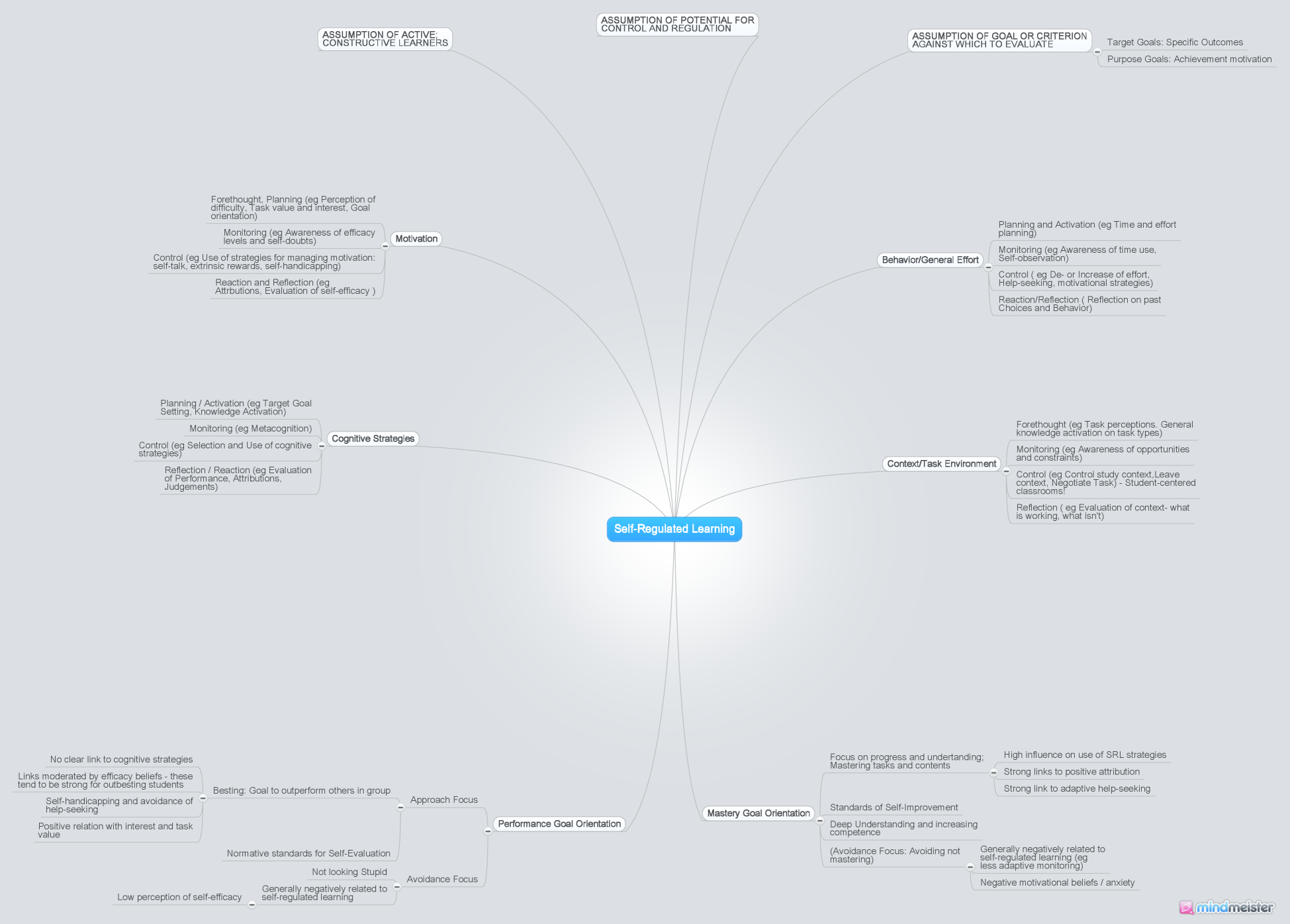
Following R. P. Pintrich’s contribution “The Role of Goal Orientation in Self-Regulated Learning” (2000), here’s a mindmap I developed in order to control my cognitive development in the field 😉 Maybe it finds one or the other interested late-night or early-bird collaborative right now, otherwise it might come in handy when wanting to revisit the concepts and linkages.

Older Entries

Design a site like this with WordPress.com
Get started